- — Who will you be without a suit?*
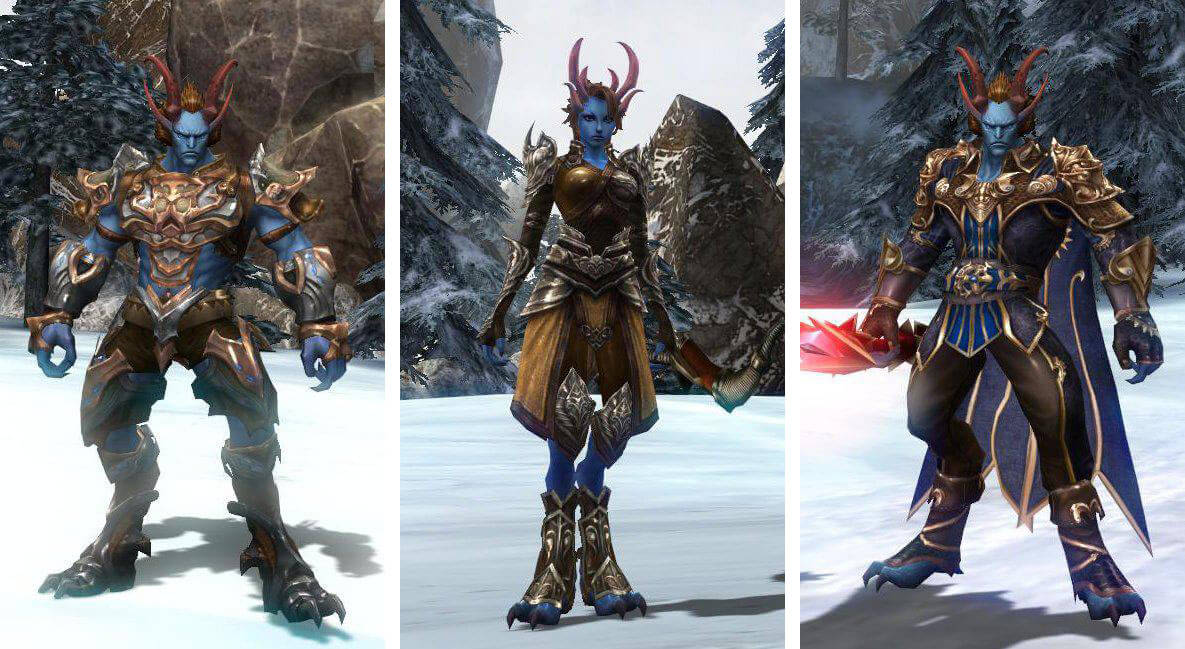
To make it easier for your character to survive and win in this harsh world, we advise you to pay special attention to equipment. The items available to the character suitable for equipment are divided into three categories: armor, weapons and jewelry
Armor is divided into types:
- heavy (warrior, paladin, barbarian)
- medium (monk, assassin, pathfinder)
- easy (priest, necromancer, sorcerer, warlock)
Jewelry includes necklaces, rings, amulets and relics.
Weapons in the game come in a variety of types, but the ones available to your character depend on their class; so the paladin will be able to pick up and use a hammer and shield, but if you've always dreamed of archery, then this class is not for you — choose a pathfinder.
Levels and quality of equipment
The quality of the received item can be quickly determined by the color of its name:
- Items with the name of the gray color have the lowest characteristics. They should be used only at the very beginning of the journey, at higher levels such equipment will not bring you any benefit.
- The names of ordinary items are written in white, their characteristics are slightly higher than those of gray, but they are also not suitable for a full-fledged game.
- Unusual items have a green name, additional combat characteristics appear on them.
-
Rare items are highlighted in blue, it's not so easy to get such equipment. There are two types of rare items: tethered upon receipt and non-tethered.
- Tethered items can be obtained from raid bosses in the dungeon and from monsters that inhabit the entire world map of the Sphere.
- Non-binding Items can be obtained from world bosses or created using a craft. Such things can be sold or transferred to another player — they will not be tied to your character.
Read more about the binding of items in this article below.
- And finally, the names of epic quality items are purple in color. These are some of the most inaccessible items in the game, but such equipment has the highest characteristics.
In addition to the difference in quality, the items also differ in level, while from a certain level (25) there is a division into classes, so in the picture below, the gloves of the one who has comprehended the secrets can only be used by representatives of the class of priests.
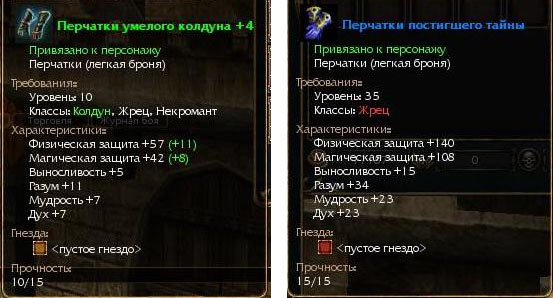
The maximum value of the basic characteristics that can be on a particular armor element is 1/12 of the character's characteristics at the level required by the armor. For example, a level 25 paladin has a basic endurance score of 112. Accordingly, on the best equipment available to a paladin at this level, the endurance bonus will be 20 units, and by dressing in a full set of six armor items (helmet, breastplate, gloves, belt, greaves and boots) your character will be able to get another 112 units to the base indicator of the characteristic. This rule works similarly for other indicators. Bonuses to other characteristics such as physical and magical defense and attack power are calculated separately.
To find out how to increase the level of characteristics of your equipment, see [article] (/eq_improv.php ).
Binding items
Item binding — pinning items to a specific character (or all characters of the account), in which only these characters can apply, equip and use these items in any other way. Before the binding, the item is no different from the usual non-binding, but after it cannot be transferred by any means to any of the characters except the characters to whom it is attached (although it can be sold to an NPC merchant or placed in a bank).
Types of binding.
- Binding to the character. After binding, the item will become available only to this particular character. Items with this type of binding after binding can only be stored in the inventory or equipment of this character or in a bank.
- Linking to an account. After binding, the item will become available to all characters of the account to which the character belongs and no one else. After binding, items with this type of binding can be stored in the inventory or equipment of any of the characters in the account or in the bank.)
You can attach an item to a character in the following ways:
- Binding upon receipt. An item is attached when it comes into the possession of a character, i.e. in his inventory or equipment.
- Binding when equipping. The item is tied when placed in one of the character's equipment cells or one of the cells for inventory bags or bank bags.
Since the item is attached when equipped, then by default, upon receipt, it is placed in the inventory, and when you try to equip it, you will see an alert that after the planned action the item will become personal, and you will have to confirm your intention to use it. - Binding when applied. The item is attached when it is first used (from the action bar or by double-clicking in the inventory).
Repairing items
Repair of items— any piece of equipment has the concept of durability and gradually loses it as it is used. If the item's durability drops to 0, the item is considered broken and you can no longer use it. To avoid this, it is necessary to use the repair of items from special NPCs in populated areas. Keep in mind that repairing costs money and the lower the durability of the item, the more expensive it will cost you to restore it.